
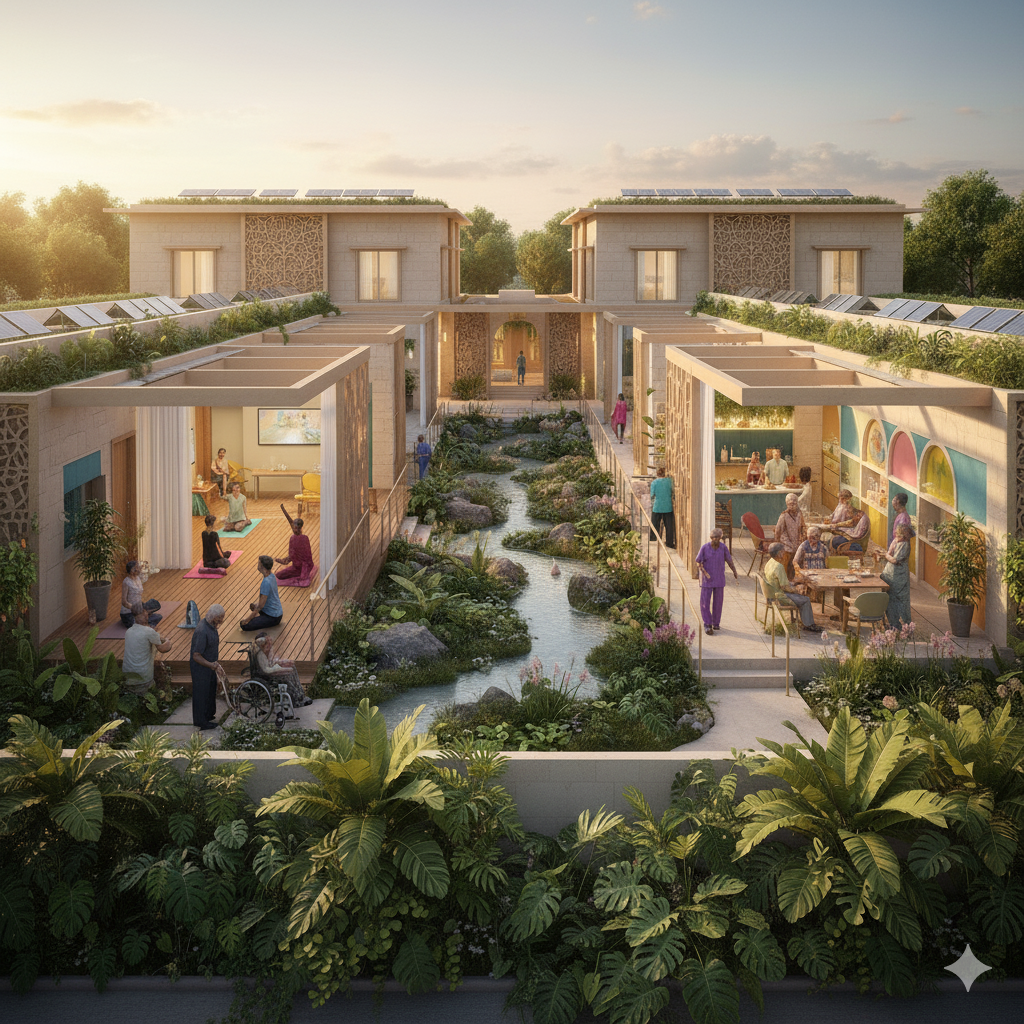
In India, mental health and elder care are two of the most underserved and stigmatized sectors in healthcare. While we talk increasingly about awareness and policy, we still ignore a foundational piece of the puzzle, infrastructure. The buildings, spaces, and environments meant to support mental wellness and elderly dignity are, more often than not, simply unfit for purpose.
As someone who designs and delivers turnkey healthcare spaces, I believe it’s time India develops a new infrastructure language, one rooted in empathy, function, and dignity, for mental health and geriatric care.
Mental Health Deserves More Than a Room With a Bed
Most “mental health” facilities in India are designed as afterthoughts, converted wings, retrofitted floors, or worse, isolated wards. But mental health care is not about confinement. It’s about connection, safety, and healing.
We need spaces that:
- Reduce visual and auditory stress
- Offer privacy without isolation
- Encourage therapeutic engagement, not institutionalization
- Incorporate nature, natural light, and open layouts to ease anxiety
The design must reflect the invisible needs, safety for those in crisis, discretion for those in therapy, and comfort for caregivers.
Elder Care Isn’t Just Beds & Railings
India’s ageing population is rising rapidly, yet our infrastructure still assumes elders will live with family, or worse, in hospital-like retirement homes.
Modern elder care spaces must shift from a clinical mindset to a community mindset:
- Barrier-free design is just the beginning.
- We need multi-sensory environments, calming lighting, textured flooring, adaptive furniture.
- Spaces must allow routine, autonomy, and familiarity, elements that reduce dementia-related disorientation and promote dignity in ageing.
At RY Hospital Projects LLP, we’ve started integrating elder-focused planning into multi-speciality hospitals, because elder care isn’t a department. It’s a design philosophy.
The Problem: Infrastructure is 10 Years Behind the Conversation
India is talking about mental health. India is talking about active ageing. But we are still building healthcare spaces like it’s 2005.
Why?
Because we don’t yet have a dedicated design language or policy framework for these needs. Architects lack exposure. Hospital owners worry about ROI. And patients are expected to “adjust.”
That mindset needs to change.
A New Language of Care
We must build mental health and elder care facilities that are:
- Sensorial and soft, not hard and cold
- Integrated and accessible, not detached and institutional
- Emotionally intelligent, not purely functional
It’s time to make empathy visible in bricks and mortar.
What the World is Doing Right
Countries like Norway, Japan, and the Netherlands are redefining dementia villages, therapy gardens, and open psychiatric clinics. They treat design as therapy.
India doesn’t lack innovation, we lack intentionality in design.
RY’s Commitment to This Change
At RY Hospital Projects LLP, we are actively pushing for:
- Dedicated zones for mental wellness in multi-specialty hospitals
- Age-inclusive design principles in early-stage planning
- Collaboration with psychologists, geriatricians, and therapists, not just engineers
Because real care doesn’t begin at diagnosis, it begins with design.
Final Word
India cannot build a healthy future while ignoring the psychological and emotional needs of its most vulnerable. Mental health and elder care deserve purpose-built, patient-centric spaces. It’s not about luxury, it’s about human dignity.
We don’t just need better hospitals.
We need more humane ones.