
Buying land for a hospital is one of the most important decisions in a healthcare project. The right location can support patient accessibility, operational efficiency, future expansion and long-term business growth. However, choosing hospital land is very different from purchasing land for a residential or commercial property.
Before finalizing a site, healthcare investors and hospital owners need to evaluate several factors, including location, accessibility, zoning, infrastructure, regulations and development potential.
A property may look ideal on paper, but if it has poor road access, inadequate utilities, unsuitable zoning or limited scope for expansion, it can create significant challenges during hospital planning and construction.
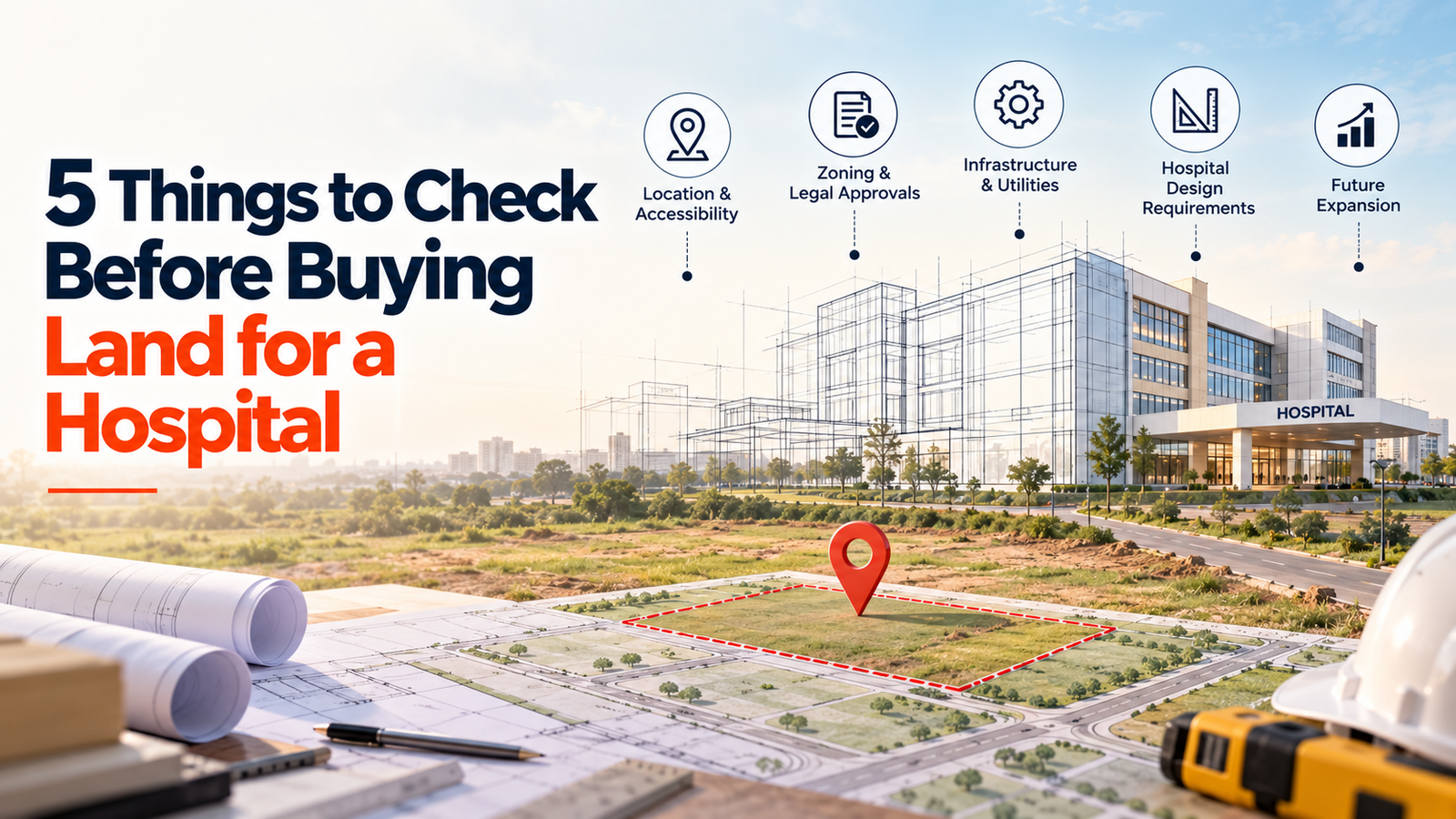
Here are five important things to check before buying land for a hospital.
1. Check the Location and Accessibility
Location is one of the first factors to evaluate when purchasing hospital land.
A hospital should be accessible to patients, attendants, doctors, nurses, emergency vehicles and other healthcare professionals. A location that is difficult to reach can affect patient footfall and emergency response times.
Before purchasing the property, evaluate:
- Connectivity with major roads and highways
- Availability of public transportation
- Distance from residential areas
- Accessibility for ambulances
- Traffic conditions around the site
- Road width and entry points
- Availability of parking space
- Proximity to supporting healthcare and commercial facilities
Emergency accessibility is particularly important. Ambulances need convenient entry and exit routes without unnecessary traffic bottlenecks.
The surrounding development should also be studied. A growing residential or commercial area may provide opportunities for future patient demand, while an isolated location may require additional marketing and accessibility planning.
A healthcare project consultant can help assess whether the proposed location is suitable for the hospital’s intended services and target patients.
2. Verify Land Use, Zoning and Legal Approvals
Before purchasing hospital land, it is essential to verify whether the property can legally be developed and used for healthcare purposes.
Not every plot is automatically suitable for hospital construction. Land-use regulations, zoning requirements, development plans and local authority rules can affect what can be built on a particular property.
Before proceeding, verify relevant documents and requirements, including:
- Ownership and title documents
- Land-use permissions
- Zoning classification
- Development permissions
- Applicable building regulations
- Road access rights
- Property boundaries
- Encumbrances or disputes
- Applicable local authority requirements
The exact permissions required can vary depending on the location and type of healthcare facility.
This stage should not be treated as a formality. Discovering a land-use restriction after purchasing the property can create expensive delays and complications.
A legal and technical due-diligence process should therefore be completed before finalizing the purchase.
3. Evaluate Infrastructure and Utility Availability
A hospital requires significantly more infrastructure than an ordinary commercial building.
Before buying the land, evaluate whether the site can support the infrastructure required for a healthcare facility.
Important considerations include:
Electricity
Hospitals require reliable electricity for medical equipment, operating theatres, intensive care units, diagnostic facilities, HVAC systems and other critical operations.
The availability and capacity of the electrical connection should be evaluated at the planning stage.
Water Supply
A hospital requires a reliable water supply for patients, staff, sanitation, housekeeping, medical services and other daily operations.
The availability of water and appropriate drainage systems should be assessed before construction.
Sewage and Drainage
Proper sewage disposal and drainage infrastructure are essential for hospital operations and hygiene.
The site should be evaluated for existing infrastructure as well as the requirements that may need to be developed as part of the project.
Medical Infrastructure
Depending on the hospital model, the project may require specialised systems such as medical gas pipelines, HVAC systems, fire protection infrastructure and backup power.
A healthcare-focused project team can identify these requirements during the initial feasibility stage.
4. Check Whether the Land Supports Your Hospital Design
A common mistake is purchasing land first and thinking about hospital design later.
Instead, the proposed hospital should be considered before the land is finalized.
The size and shape of the plot can influence:
- Number of hospital beds
- Floor planning
- Operation theatre placement
- ICU capacity
- Emergency department access
- Parking
- Patient circulation
- Staff circulation
- Service areas
- Fire access
- Future expansion
For example, a plot may have sufficient total area but an inefficient shape that makes hospital planning difficult.
The site should therefore be evaluated from an architectural and functional perspective.
An experienced hospital architectural design team can assess whether the land can accommodate the proposed hospital model and its functional requirements.
This is also where a hospital interior designing firm can eventually contribute by planning patient areas, consultation rooms, waiting spaces and clinical environments around the hospital’s operational requirements.
5. Think About Future Expansion and Long-Term Growth
Hospital development should not be planned only for today’s requirements.
Healthcare businesses can expand as patient demand increases. A hospital may eventually need additional beds, new specialties, diagnostic facilities, larger emergency services or upgraded patient amenities.
Before purchasing land, ask:
Can this site support the hospital’s future growth?
Consider whether there is sufficient space for:
- Additional floors
- New clinical departments
- More patient rooms
- Expanded diagnostic facilities
- Additional parking
- Staff facilities
- New medical equipment
- Future buildings or healthcare services
Future expansion should be considered during the initial feasibility study rather than after construction has already begun.
A well-planned site can provide greater flexibility and reduce the need for major redevelopment later.
Conduct a Proper Hospital Land Feasibility Study
Before purchasing hospital land, it is advisable to conduct a comprehensive feasibility assessment.
A land feasibility study can bring together several factors, including location, accessibility, legal considerations, land use, infrastructure, site dimensions, hospital capacity and future development possibilities.
This helps healthcare investors make a decision based on facts rather than simply selecting a property because of its location or price.
The feasibility process can also identify potential risks before significant capital is committed.
Why Professional Hospital Project Planning Matters
Hospital projects involve multiple stages, from concept development and site assessment to architecture, engineering, interiors, approvals and construction.
Choosing the land is therefore closely connected to the entire hospital development strategy.
Professional hospital turnkey solutions can help coordinate different aspects of a healthcare project under an integrated approach. Instead of treating land assessment, design, infrastructure and execution as completely separate activities, the project can be evaluated as a complete healthcare development.
This can help identify potential issues early and create a more practical roadmap for development.
Don’t Buy Hospital Land Based on Price Alone
The cheapest plot is not necessarily the most economical option for a hospital.
A low-cost property may have poor accessibility, insufficient infrastructure, legal complications or limited expansion potential. These issues can increase project costs later.
Similarly, a slightly more expensive site with better connectivity, infrastructure and development potential may provide greater long-term value.
The right question is not simply:
“How much does the land cost?”
Instead, ask:
“Can this land support a successful hospital?”
That distinction can significantly influence the success of the entire healthcare project.
Final Thoughts
Buying land for a hospital is a strategic decision that should be made after detailed technical, legal and commercial evaluation.
Before finalizing a property, check its location and accessibility, verify zoning and legal requirements, assess utilities and infrastructure, evaluate whether the site supports your proposed hospital design and consider future expansion.
A hospital is a long-term investment. The land selected today can influence construction costs, patient accessibility, operational efficiency and future growth for many years.
With proper feasibility planning and professional guidance, healthcare investors can make more informed land-acquisition decisions and build a stronger foundation for their hospital project.
Planning a new hospital? Start with the right site, the right strategy and the right project partner. RY Hospital Projects LLP can support healthcare projects with hospital turnkey solutions, planning, design and project management.
FAQs
1. What should I check before buying land for a hospital?
Check location, accessibility, zoning, legal status, infrastructure, utilities, site dimensions and future expansion potential.
2. Why is location important for hospital land?
Good accessibility helps patients, staff and emergency vehicles reach the hospital more easily and can support long-term patient demand.
3. Can any commercial land be used to build a hospital?
Not necessarily. Land use, zoning and local development regulations must be verified before purchasing the property.
4. Why should future expansion be considered before buying hospital land?
Future expansion planning can provide space for additional beds, departments, parking and medical facilities as the hospital grows.
5. What are hospital turnkey solutions?
Hospital turnkey solutions provide an integrated approach to planning, design, coordination and execution of healthcare projects.