
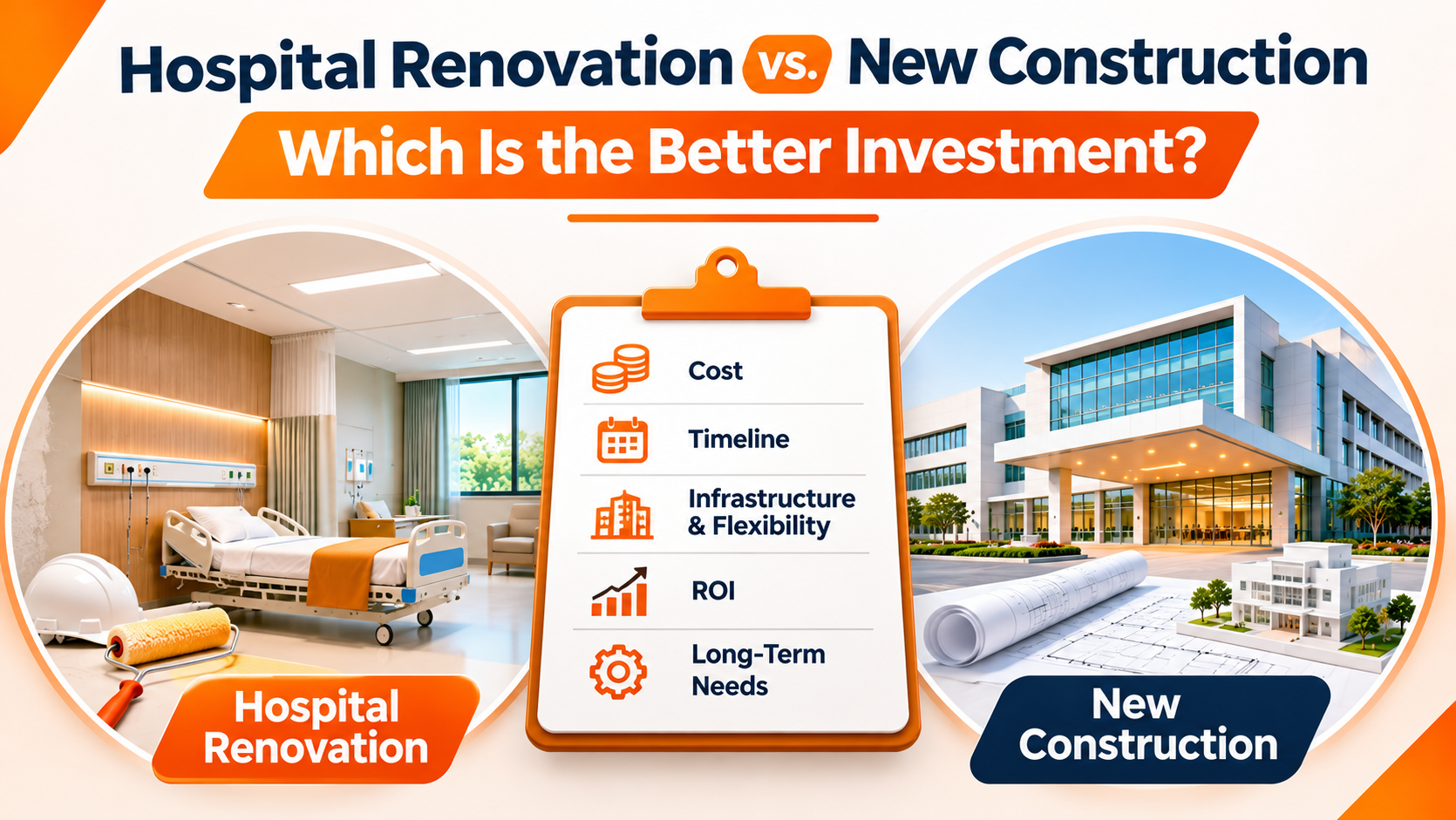
Healthcare infrastructure is continuously evolving with changing patient expectations, advancements in medical technology, and increasing demand for specialised healthcare services. For hospital owners and healthcare investors, maintaining modern infrastructure is essential for delivering quality patient care and ensuring efficient hospital operations.
However, when an existing hospital requires significant upgrades or additional facilities, healthcare providers often face an important decision: Should they renovate the existing hospital or invest in developing a completely new healthcare facility?
Both options offer different advantages and challenges. Hospital renovation can help upgrade existing infrastructure, improve patient experience, and extend the usability of an existing building. On the other hand, new hospital construction provides greater flexibility in architectural planning, departmental layouts, and specialised medical infrastructure.
The right investment decision depends on several factors, including building conditions, available space, project budget, patient demand, infrastructure requirements, and long-term business objectives.
Let’s explore the key differences between hospital renovation and new construction to help healthcare providers make informed decisions.
1. Understanding Hospital Renovation
Hospital renovation involves upgrading or modifying an existing healthcare facility to improve its functionality, appearance, safety, and operational efficiency.
Renovation projects can range from minor interior improvements to major infrastructure upgrades involving multiple departments.
For example, a hospital may renovate its OPD, upgrade patient rooms, modernise its reception area, improve ICU infrastructure, or redesign its operation theatres.
Common hospital renovation activities include:
- Upgrading patient rooms and inpatient wards.
- Modernising OPD and consultation areas.
- Improving reception and waiting areas.
- Renovating ICUs and operation theatres.
- Upgrading electrical and plumbing infrastructure.
- Improving HVAC and ventilation systems.
- Replacing outdated flooring, ceilings, and furniture.
- Improving accessibility and patient movement.
Hospital renovation can be a practical investment when the existing building has a suitable structure and sufficient space to accommodate modern healthcare requirements.
2. Understanding New Hospital Construction
New hospital construction involves developing a healthcare facility from the ground up. Unlike renovation, it provides healthcare investors with an opportunity to plan the entire building according to their clinical, operational, and future business requirements.
The planning process begins with evaluating the project location, expected patient capacity, healthcare specialities, land availability for hospital, infrastructure requirements, and investment budget.
Major stages of new hospital construction include:
- Site assessment and feasibility analysis.
- Hospital architecture planning and design.
- Departmental space planning.
- Structural and engineering design.
- Electrical, plumbing, and HVAC planning.
- Medical gas infrastructure planning.
- Interior design and material selection.
- Construction and project execution.
- Installation coordination and final handover.
New construction provides greater flexibility in developing specialised departments, improving patient circulation, and incorporating modern healthcare infrastructure from the initial design stage.
3. Cost Comparison: Hospital Renovation vs. New Construction
Budget is one of the most important factors when deciding between renovation and new construction.
Hospital renovation may require a lower initial investment if the existing building is structurally sound and its infrastructure can support the proposed upgrades.
However, renovation costs can increase when hidden structural problems, outdated electrical systems, plumbing issues, or major layout modifications are discovered during execution.
New construction generally requires a larger overall investment because it involves land development, structural construction, engineering, interiors, and infrastructure installation.
Factors affecting renovation costs:
- Existing building condition.
- Required structural modifications.
- Electrical and plumbing upgrades.
- HVAC and ventilation improvements.
- Interior finishing and material selection.
- Departmental relocation requirements.
Factors affecting new construction costs:
- Land acquisition and site development.
- Building size and structural requirements.
- Architectural and engineering design.
- Medical infrastructure installation.
- Interior development and finishing.
- Regulatory approvals and compliance requirements.
Hospital owners should compare the total project cost rather than focusing only on the initial construction or renovation budget.
4. Project Timeline and Operational Disruption
Time is another important consideration, particularly for hospitals that are already operational.
Renovation may take less time than new construction when the work is limited to specific departments or interior upgrades. However, working within an existing hospital can be challenging because patient care and daily operations may need to continue during the renovation.
Noise, dust, restricted access, and departmental relocation can affect hospital functioning.
New construction generally involves a longer development timeline, but it allows construction activities to take place without directly disturbing an existing hospital’s operations.
How to manage renovation disruptions:
- Divide renovation into manageable phases.
- Schedule work to minimise patient inconvenience.
- Maintain separate construction and patient movement routes.
- Plan temporary departmental arrangements.
- Follow appropriate infection-control and safety procedures.
A detailed execution schedule helps hospital owners manage project activities while maintaining essential healthcare services.
5. Space Utilisation and Hospital Architecture Planning
Space availability can significantly influence the decision between renovation and new construction.
Existing hospitals may have limited opportunities for expansion because of structural restrictions, insufficient floor space, or poorly planned departmental layouts.
For example, an older hospital may not have enough space to accommodate additional ICU beds, modern diagnostic equipment, or specialised treatment facilities.
New construction offers greater flexibility to develop layouts according to present and future healthcare requirements.
Professional hospital architecture planning and design helps ensure that departments are positioned strategically, patient movement is convenient, and technical infrastructure is properly coordinated.
Important planning considerations include:
- OPD and consultation areas.
- Emergency department access.
- ICU and operation theatre layouts.
- Diagnostic and laboratory departments.
- Patient rooms and inpatient wards.
- Medical equipment requirements.
- Staff and service circulation.
- Future expansion possibilities.
The objective is to develop a functional healthcare environment that supports efficient hospital operations.
6. Modern Medical Infrastructure and Technology Integration
Healthcare technology continues to advance, and hospitals must adapt their infrastructure to accommodate new medical equipment and specialised treatment requirements.
During renovation, integrating modern technology into an older building can sometimes be challenging because of existing electrical layouts, ceiling heights, structural restrictions, and limited utility spaces.
New construction allows medical infrastructure requirements to be considered during the initial design stage.
These may include:
- Advanced electrical systems and backup power.
- Medical gas pipeline infrastructure.
- Modern HVAC and ventilation systems.
- Diagnostic equipment installation requirements.
- Hospital IT and communication networks.
- Specialised ICU and OT infrastructure.
However, renovation can also provide an opportunity to modernise an existing facility when the building can support the required technical upgrades.
7. Long-Term Return on Investment and Future Expansion
Hospital infrastructure decisions should not be based only on immediate expenses. Healthcare providers must also consider long-term operational efficiency, patient demand, maintenance requirements, and revenue opportunities.
Renovation can improve the performance of an existing hospital by upgrading outdated spaces and making better use of available infrastructure.
New construction may offer greater long-term flexibility by allowing investors to develop additional departments, increase patient capacity, and incorporate future expansion provisions.
A feasibility assessment should consider:
- Expected patient demand.
- Existing and projected bed capacity.
- Operational and maintenance expenses.
- Cost of infrastructure upgrades.
- Potential departmental expansion.
- Long-term healthcare business objectives.
The better investment is the option that provides sustainable value while supporting the hospital’s operational and financial goals.
8. How to Decide Between Hospital Renovation and New Construction?
There is no single solution for every healthcare provider. The right approach depends on the existing facility, investment capacity, and future development plans.
Hospital renovation may be suitable when:
- The existing building has a sound structure.
- Available space can accommodate required upgrades.
- Existing infrastructure can be modernised.
- The hospital wants to improve specific departments.
- A complete redevelopment is not financially practical.
New construction may be suitable when:
- The existing building has major structural limitations.
- Available space is insufficient.
- The hospital requires substantial additional capacity.
- Specialised departments need dedicated infrastructure.
- Long-term expansion is a major priority.
Consulting experienced hospital management consultants in India can help healthcare investors assess project feasibility, infrastructure requirements, operational considerations, and investment priorities before making a final decision.
Why Choose RY Hospital Projects for Hospital Development?
Whether you are renovating an existing hospital or developing a new healthcare facility, successful execution requires coordination between architects, designers, engineers, contractors, and healthcare infrastructure specialists.
RY Hospital Projects focuses on hospital infrastructure development, planning, and interior execution to support healthcare providers in creating functional and modern medical facilities.
With expert turnkey solutions, hospital owners can approach different stages of project development through a coordinated process, from initial planning and design to technical coordination and final execution.
The focus should always remain on developing healthcare environments that support patient comfort, operational efficiency, safety, and long-term functionality.
Conclusion
Choosing between hospital renovation and new construction is an important investment decision for healthcare providers.
Renovation can be a cost-effective option when the existing building is suitable for modernisation, while new construction provides greater flexibility for developing specialised departments and future-ready infrastructure.
Before making a decision, hospital owners should evaluate building conditions, space availability, infrastructure requirements, patient demand, project costs, and long-term expansion opportunities.
With professional hospital architecture planning and design, detailed feasibility assessments, and expert turnkey solutions, healthcare investors can make informed infrastructure decisions that support sustainable growth and better healthcare delivery.
Frequently Asked Questions (FAQs)
1. Is hospital renovation cheaper than new construction?
Hospital renovation can require a lower initial investment when the existing structure and infrastructure are suitable. However, extensive structural and technical upgrades can increase renovation costs.
2. When should a hospital consider new construction?
New construction may be suitable when the existing building has major structural limitations, insufficient space, or cannot accommodate modern medical infrastructure and future expansion requirements.
3. What factors should be considered before renovating a hospital?
Important factors include structural conditions, available space, electrical and plumbing infrastructure, HVAC systems, patient safety, departmental requirements, and project budget.
4. How does hospital architecture planning improve healthcare facilities?
Professional hospital architecture planning helps optimise space utilisation, departmental connectivity, patient movement, technical infrastructure, and operational efficiency.
5. Why should hospital owners consult hospital management consultants in India?
Experienced consultants can help evaluate project feasibility, infrastructure requirements, operational needs, and investment considerations to support better hospital development decisions.