
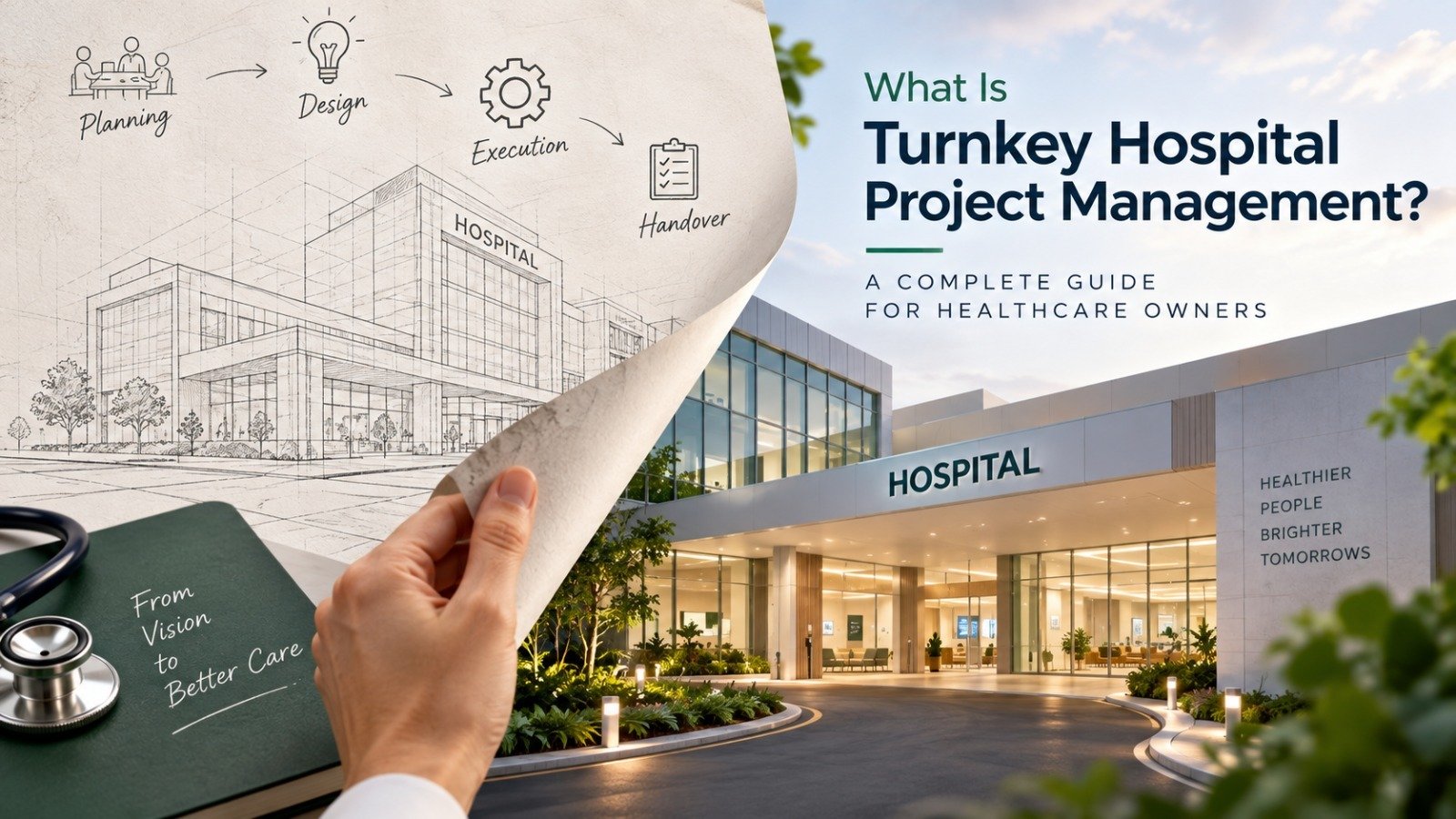
Planning and developing a hospital is significantly more complex than constructing a conventional commercial building. Healthcare facilities require specialized planning, clinical workflows, medical infrastructure, safety systems, regulatory compliance, advanced equipment, and patient-focused interiors.
Turnkey hospital project management is an integrated approach in which a specialized project partner manages multiple stages of a healthcare project—from initial planning and design through procurement, execution, installation, testing, commissioning, and final handover.
Instead of a healthcare owner coordinating separately with architects, contractors, consultants, vendors, engineers, and equipment suppliers, a turnkey partner provides a centralized project management structure.
The objective is straightforward: plan, design, execute, coordinate, and deliver a functional healthcare facility with greater control over quality, timelines, and costs.
For healthcare owners, this approach can significantly reduce the complexity involved in developing a hospital or upgrading an existing healthcare facility.
Why Is Hospital Project Management Different?
A hospital is a highly specialized environment where architecture and infrastructure directly influence patient care and staff efficiency.
A hospital project may involve:
- Emergency departments
- Operation theatres
- ICUs and critical care areas
- Patient rooms
- Diagnostic departments
- Laboratories
- Pharmacies
- Consultation rooms
- Medical gas systems
- HVAC and infection-control requirements
- Electrical and backup power systems
- Fire safety systems
- Nurse call systems
- Medical equipment
- Specialized healthcare interiors
Each department must be planned according to its operational requirements while maintaining appropriate movement patterns for patients, doctors, nurses, visitors, equipment, and supplies.
This is why effective hospital planning and project management requires healthcare-specific expertise rather than simply conventional construction experience.
What Does a Turnkey Hospital Project Include?
A turnkey hospital project can cover several interconnected stages. The exact scope depends on the project’s size, location, specialty, budget, and requirements.
1. Feasibility and Initial Planning
The project starts with understanding the healthcare owner’s objectives.
Important questions include:
- What type of hospital is being planned?
- How many beds are required?
- Which specialties will be offered?
- What departments are needed?
- Who is the target patient population?
- What is the available budget?
- What is the expected project timeline?
- What are the site limitations?
A feasibility assessment can help healthcare owners establish realistic project objectives before significant capital is committed.
2. Hospital Master Planning
Master planning establishes the overall framework of the healthcare facility.
It may include departmental zoning, circulation planning, space requirements, patient flow, staff movement, service areas, and future expansion requirements.
Good planning can help prevent expensive modifications later.
For example, the relationship between emergency services, imaging, laboratories, operating theatres, ICUs, and inpatient areas needs to be carefully considered before construction begins.
3. Architectural and Interior Design
Hospital architecture should balance functionality, safety, efficiency, and patient comfort.
A turnkey healthcare project may include:
- Architectural planning
- Space planning
- Interior design
- Department layouts
- Patient room planning
- OT and ICU planning
- Reception and waiting areas
- Wayfinding
- Nurse stations
- Material selection
- Accessibility considerations
The design should also consider clinical workflows and operational requirements.
RY Hospital Projects describes its approach as combining healthcare-focused architectural planning, functionality, patient-centric environments, and turnkey execution.
4. Engineering and MEP Coordination
Mechanical, Electrical and Plumbing (MEP) systems are fundamental to hospital infrastructure.
Depending on the facility, planning may involve:
- HVAC systems
- Electrical systems
- Plumbing
- Firefighting systems
- Medical Gas Pipeline Systems (MGPS)
- Backup power
- Specialized ventilation
- Water management
- Drainage systems
These systems must be coordinated with architectural layouts and medical requirements.
Poor coordination between design and engineering teams can lead to clashes, rework, delays, and additional costs.
5. Procurement and Vendor Coordination
Hospital projects involve numerous products, materials, systems, and specialist vendors.
A turnkey project management team can coordinate:
- Material procurement
- Contractor selection
- Vendor coordination
- Equipment suppliers
- Interior materials
- Specialized healthcare systems
- Installation schedules
Centralized coordination can make communication easier and help ensure that procurement aligns with the construction schedule.
6. Construction and Project Execution
Once planning and design are finalized, the project moves into execution.
Project management during this phase may include:
- Contractor coordination
- Site supervision
- Quality monitoring
- Schedule tracking
- Material inspections
- Budget monitoring
- Safety coordination
- Design clarification
- Progress reporting
A dedicated project manager acts as the coordination point between the healthcare owner and the various teams involved in execution.
7. Medical Equipment Planning and Integration
Medical equipment should not be treated as an afterthought.
Equipment planning can influence room dimensions, electrical requirements, HVAC requirements, medical gas connections, flooring, ceiling systems, access routes, and other infrastructure.
Depending on the project scope, turnkey hospital execution may therefore include coordination for medical equipment installation and integration.
The goal is to ensure that the physical infrastructure is ready when equipment arrives.
8. Quality Control and Compliance
Healthcare facilities have stringent safety and operational requirements.
A professional hospital project management process should incorporate quality checks throughout the project rather than waiting until the end.
Important considerations may include:
- Fire safety
- Electrical safety
- Infection-control considerations
- Accessibility
- Healthcare design standards
- Applicable statutory requirements
- Quality of construction materials
- Testing of critical systems
Where applicable, project teams also need to consider requirements associated with healthcare accreditation and regulatory frameworks.
9. Testing, Commissioning and Handover
The project does not end when construction is complete.
Before the facility becomes operational, different systems and installations need to be inspected, tested, and commissioned according to their requirements.
The final stage may include:
- System testing
- Equipment installation checks
- MEP testing
- Fire and safety checks
- Snag rectification
- Documentation
- Final inspections
- Handover
A well-managed handover ensures the healthcare owner receives a facility that is prepared for operational use.
Key Benefits of Turnkey Hospital Project Management
- Single-Point Project Coordination
Instead of managing multiple independent agencies, healthcare owners can work with a centralized project management partner.
This simplifies communication and decision-making.
- Better Timeline Management
Hospital projects involve numerous interconnected activities. Delays in one area can affect several others.
Professional scheduling and coordination help identify dependencies and manage project milestones more effectively.
- Improved Cost Control
Budget management begins during planning and continues throughout execution.
Regular monitoring can help identify variations, unnecessary expenses, procurement issues, and potential cost overruns earlier.
- Reduced Execution Complexity
Healthcare owners do not necessarily need to manage every technical detail themselves.
A turnkey partner coordinates architects, engineers, contractors, vendors, and other specialists.
- Healthcare-Specific Expertise
Hospital projects require knowledge beyond conventional building construction.
A specialized healthcare project management team understands the relationship between infrastructure, clinical workflows, patient experience, and operational efficiency.
- Better Quality Control
A structured project management process can establish quality checkpoints across design, procurement, construction, installation, and commissioning.
RY Hospital Projects states that its hospital project management services cover planning, cost control, scheduling, vendor and contractor coordination, compliance, quality assurance, risk management, and turnkey delivery.
Turnkey vs. Traditional Hospital Project Management
| Turnkey Approach | Traditional Multiple-Contractor Approach |
|---|---|
|
Centralized project coordination |
Multiple independent parties |
|
Integrated planning and execution |
Separate planning and execution |
| Easier communication |
More communication points |
|
Coordinated scheduling |
Greater risk of schedule conflicts |
|
Centralized responsibility |
Responsibility distributed across vendors |
|
Integrated quality management |
Quality may vary between contractors |
|
Simplified owner involvement |
Greater owner-side coordination |
The right approach depends on the healthcare owner’s objectives, project size, internal team, and desired level of involvement.
How Healthcare Owners Should Choose a Turnkey Partner
Before selecting a turnkey hospital project management company, healthcare owners should evaluate:
Healthcare Experience
Look for experience with hospitals, clinics, diagnostic centres, OTs, ICUs, and other specialized healthcare environments.
Complete Service Capability
Check whether the company can coordinate planning, architecture, engineering, interiors, procurement, execution, and handover.
Project Portfolio
Review completed healthcare projects rather than relying only on general construction experience.
Project Management Process
Ask how the company manages budgets, schedules, vendors, quality control, documentation, and risks.
Compliance Knowledge
Healthcare projects require careful attention to applicable safety and regulatory requirements.
Communication
Clear reporting and regular project updates can help owners make informed decisions throughout execution.
Why Turnkey Project Management Is Valuable for Healthcare Owners
For a healthcare owner, developing a hospital is not simply a construction investment. It is the creation of an environment where doctors, nurses, technicians, patients, and support teams need to work efficiently.
A successful hospital project therefore requires the integration of planning, architecture, engineering, construction, interiors, technology, medical infrastructure, compliance, and operational requirements.
A turnkey approach brings these elements together under a coordinated framework.
With the right project management partner, healthcare owners can spend less time managing fragmented execution and more time focusing on their healthcare vision and future operations.
RY Hospital Projects offers end-to-end turnkey solutions covering healthcare planning, architectural design, project management, and execution, with its services positioned around creating functional and patient-focused healthcare environments.
Conclusion
Turnkey hospital project management provides healthcare owners with an integrated way to plan and execute complex healthcare infrastructure projects. From feasibility and architectural planning to engineering, procurement, construction, interiors, equipment coordination, testing, and handover, every stage can be managed as part of one coordinated process.
For owners planning a new hospital, expanding an existing facility, developing a specialty centre, or renovating a healthcare environment, choosing an experienced turnkey partner can help improve coordination, control project risks, and create a facility designed around patient care and operational efficiency.
With healthcare infrastructure becoming increasingly specialized, professional hospital project management is no longer just about completing construction—it is about delivering a healthcare facility that is functional, safe, efficient, and ready for the future.
FAQs
1. What is turnkey hospital project management?
Turnkey hospital project management is an end-to-end approach where a specialized partner coordinates planning, design, procurement, construction, installation, testing, and final handover of a healthcare facility.
2. What is included in a turnkey hospital project?
Depending on the scope, it can include feasibility planning, architecture, interiors, engineering, MEP coordination, procurement, construction, equipment coordination, quality control, commissioning, and handover.
3. What are the benefits of turnkey hospital projects?
They provide centralized coordination, better project control, simplified communication, improved timeline management, cost monitoring, and healthcare-specific project expertise.
4. How do I choose a turnkey hospital project management company?
Evaluate the company’s healthcare experience, completed projects, technical capabilities, project management process, quality controls, compliance knowledge, and ability to manage the project from planning through handover.